auto.wikisort.org - Automobile
The Jowett Bradford was a British light van produced from 1946 to 1953 by Jowett Cars Ltd of Idle, near Bradford, England. It was also available as an estate car from 1947 to 1953.
| Jowett Bradford | |
|---|---|
 | |
| Overview | |
| Manufacturer | Jowett Cars Ltd |
| Production | 1946–1953. 38,241 made [1] |
| Body and chassis | |
| Body style | van, estate |
| Layout | FR |
| Related | Jowett 8[2] |
| Powertrain | |
| Engine | Jowett side-valve flat twin, 1005 cc[3] |
| Transmission | 3-speed manual |
| Dimensions | |
| Wheelbase | 2,286 mm (90 in) [3][4] |
| Length | 3,658 mm (144 in) [4] |
| Width | 1,524 mm (60 in) [3][4] |
| Height | 1,753 mm (69 in) [4] |
The vehicle was based on the pre-war Jowett Eight[2] and was the first Jowett to be re-introduced after the Second World War. Although it was very basic, the Bradford's economy and availability appealed to the post-war market.
Design features
The chassis featured half-elliptic leaf springs front and rear with beam axles. The front-mounted flat-twin engine produced 19 bhp (14 kW) and drove the rear wheels through a three-speed non-synchromesh gearbox. In 1950 the engine was updated to give 25 bhp (19 kW)[4] and synchromesh was fitted to the top ratio. This improved the top speed to 53 mph (85 km/h). The 10 in (254 mm) drum brakes were operated mechanically using a Girling system.
Body variants

Initially only a 10 cwt van version was made but in 1947 it was joined by an estate car, the Utility.[citation needed] This was little more than the van with side windows and rear seats. By 1951 the Utility was offered in two versions: Utility and Utility De Luxe, with the latter having better trim, including a rear bumper and side footsteps.[5] Both utilities were also offered as a '4-light van', with windows but no rear seats, to avoid the high purchase tax on private cars.[5] The Bradford was also manufactured as a light lorry,[5] as would later be described as a pickup truck.
Driveaway-chassis and cab-chassis versions were made for outside coachbuilders, in which form it sold in large numbers at home and abroad.[citation needed]
Performance
A Utility de-luxe tested by the British magazine The Motor in 1952 had a top speed of 53.4 mph (85.9 km/h) and could accelerate from 0–50 mph (80 km/h) in 47.6 seconds. A fuel consumption of 34.5 miles per imperial gallon (8.2 L/100 km; 28.7 mpg‑US) was recorded. The test car cost £740 including taxes. The de-luxe specification, which included trafficators, dual windscreen wipers, running boards, a rear bumper and some chromium plating, added £38 to the total cost.[4]
Development
A saloon and a pickup with inlet-over-exhaust cylinder heads was being developed when Jowett stopped making cars and vans.[3]
Gallery
 1951 10 cwt (½ ton) lorry
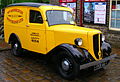 10 cwt (½ ton) van registered October 1948
 van to "station wagon" private conversion registered March 1952
 standard 6-light van or Utility Car either 2 or 4 seats registered March 1948 Stondon Museum
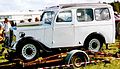 de luxe Utility Car with three rows of two seats and like the standard model 8 cwt springs
 Rolling chassis of a 1948 van
 ice cream van in Liverpool
 badge
badge badge
badge


References
- Sedgwick, M.; Gillies, M. (1986). A-Z of Cars 1945–1970. Bay View Books. ISBN 1-870979-39-7.
- Culshaw, David; Horrobin, Peter (2013) [1974]. "Jowett". The Complete Catalogue of British Cars 1895–1975 (e-book ed.). Veloce Publishing. pp. 188–189. ISBN 978-1-845845-83-4.
- Culshaw & Horrobin, The Complete Catalogue of British Cars 1895–1975, "Bradford", p. 373
- "The Bradford Utility de-luxe". The Motor. 23 June 1952.
- 4 famous Bradfords, Jowett sales leaflet (1951)
External links

Другой контент может иметь иную лицензию. Перед использованием материалов сайта WikiSort.org внимательно изучите правила лицензирования конкретных элементов наполнения сайта.
WikiSort.org - проект по пересортировке и дополнению контента Википедии