auto.wikisort.org - Automobile
The Perodua Kenari is a city car produced by Malaysian automotive company Perodua. The Kenari is based on the second generation Daihatsu Move kei car (minicar) with a 990 cc DOHC engine powering it. The name Kenari is a Malaysian name equivalent to the word canary, which translates to joy and freedom.
| Perodua Kenari (L900) | |
|---|---|
 | |
| Overview | |
| Manufacturer | Perodua |
| Also called | Daihatsu Move (L900) |
| Production | 2000–2009 |
| Body and chassis | |
| Class | City car |
| Body style | 5-door hatchback |
| Layout | Front-engine, front-wheel-drive |
| Powertrain | |
| Engine | 990 cc EJ-DE DOHC I3 |
| Dimensions | |
| Wheelbase | 2,360 mm (92.9 in) |
| Length | 3,460 mm (136.2 in) |
| Width | 1,500 mm (59.1 in) |
| Height | 1,660 mm (65.4 in) |
| Kerb weight | 865–880 kg (1,907–1,940 lb) |
History
The Perodua Kenari was launched in 2000 with three variants: EX (Standard) (5-speed manual), GX (Deluxe) (5-speed manual) and EZ (4-speed automatic).[1]
In April 2003, Perodua introduced the facelift model. Changes included new headlights, a new front grille and a 14" alloy wheel design that became standard throughout the 4-model range: GX, EZ, EZ Special (EZS) and GX Aero. The GX Aero was offered only with a manual transmission and was only available in Mistik Red. It had a body kit consisting of side skirts, a different spoiler and different styling for the rear lighting units. The interior of the GX Aero featured "cubic" printing on the centre dashboard console surfaces.[2][3]
In September 2003, the company showed a hybrid version of the Perodua Kenari that didn't make it to production. The prototype used a 659 cc petrol engine which produced 30 kW/41 bhp of power and 57 Nm of torque, coupled to an electric motor that generated 18 kW/25 bhp of power and 100 Nm of torque.[4]
In November 2006, the company introduced the Perodua Kenari RS.[5]
Perodua discontinued sales of the Kenari in 2009 with no direct replacement model.
Variants
 | This list is incomplete; you can help by adding missing items. (September 2017) |
Malaysia
| Model years | Variant (Known As) | Transmission |
|---|---|---|
| 2000-2003 (between March and) | EX (Standard) | Manual |
| 2000-? | GX (Deluxe) | |
| 2003-? | GX Aero (Aerosport) | |
| 2004[6]-2006[7] | GX Kasih (Kasih) | |
| 2000-2004 | EZ (DOHC) | Automatic |
| 2005-2008 | EZ Aero (Aerosport) | |
| 2004[6] - 2006[7] | EZ Kasih (Kasih) | |
| 2002 | EZ Limited Edition[8] | |
| 2003 - ? | EZS (EZ Special) | |
| ? | Special Edition[9] | |
| 2006 - ? | RS |
Gallery
 2000-2003 Pre-facelift (front)
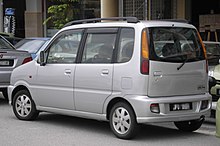 2000-2003 Pre-facelift (rear)
 2000-2003 Pre-facelift (front)
 2000-2003 Pre-facelift (rear)
 Facelift, Aero/AeroSport (front)
 Facelift, Aero/AeroSport (side)


Export
Perodua exported the Kenari to the United Kingdom in two variants: GX and EZ.[10]
Powertrain
| Manufacturer's claims | |
|---|---|
| Engine | 989 cc EJ-DE |
| Format | DOHC 12V I3 |
| Total displacement (cc) | 989 |
| Bore x Stroke (mm x mm) | 72.0 x 81.0 |
| Maximum Output [hp(kW)/rpm] | 54 (40.3) / 5,200 |
| Maximum Torque (Nm/rpm) | 88 / 3,200 |
| Maximum Speed (km/h) | 155 km/h |
| Acceleration 0–100 km/h (sec) | 12.5 |
| Fuel efficiency | 4.8l / 100km (highway: 80km/H constant) |
References
- "Perodua.com :: News & Events :: 2000". 2005-12-26. Archived from the original on 2005-12-26. Retrieved 2017-09-03.
{{cite web}}: CS1 maint: bot: original URL status unknown (link) - "Perodua.com :: News & Events :: 2003". 2006-12-12. Archived from the original on 2006-12-12. Retrieved 2017-09-03.
{{cite web}}: CS1 maint: bot: original URL status unknown (link) - "2003 Perodua Kenari - Autoworld.com.my". Autoworld.com.my. 2003-04-15. Retrieved 2017-12-05.
- "Perodua's High-tech Future - Autoworld.com.my". Autoworld.com.my. 2003-09-04. Retrieved 2017-12-05.
- "Perodua :: News & Events :: latest_updates". 2007-03-05. Archived from the original on 2007-03-05. Retrieved 2017-09-03.
{{cite web}}: CS1 maint: bot: original URL status unknown (link) - "Perodua.com :: Our Cars :: kenari :: price". 2004-11-25. Archived from the original on 2004-11-25. Retrieved 2017-09-03.
{{cite web}}: CS1 maint: bot: original URL status unknown (link) - "Perodua.com :: Our Cars :: kenari :: price". 2006-04-27. Archived from the original on 2006-04-27. Retrieved 2017-09-03.
{{cite web}}: CS1 maint: bot: original URL status unknown (link) - "Welcome to the Official Perodua Website". 2001-07-19. Archived from the original on 2001-07-19. Retrieved 2017-09-03.
{{cite web}}: CS1 maint: bot: original URL status unknown (link) - "Welcome to the Official Perodua Website". 2002-10-16. Archived from the original on 2002-10-16. Retrieved 2017-09-03.
{{cite web}}: CS1 maint: bot: original URL status unknown (link) - "Perodua UK Current Models". 2003-04-12. Archived from the original on 2003-04-12. Retrieved 2017-09-03.
{{cite web}}: CS1 maint: bot: original URL status unknown (link)
External links
Другой контент может иметь иную лицензию. Перед использованием материалов сайта WikiSort.org внимательно изучите правила лицензирования конкретных элементов наполнения сайта.
WikiSort.org - проект по пересортировке и дополнению контента Википедии